

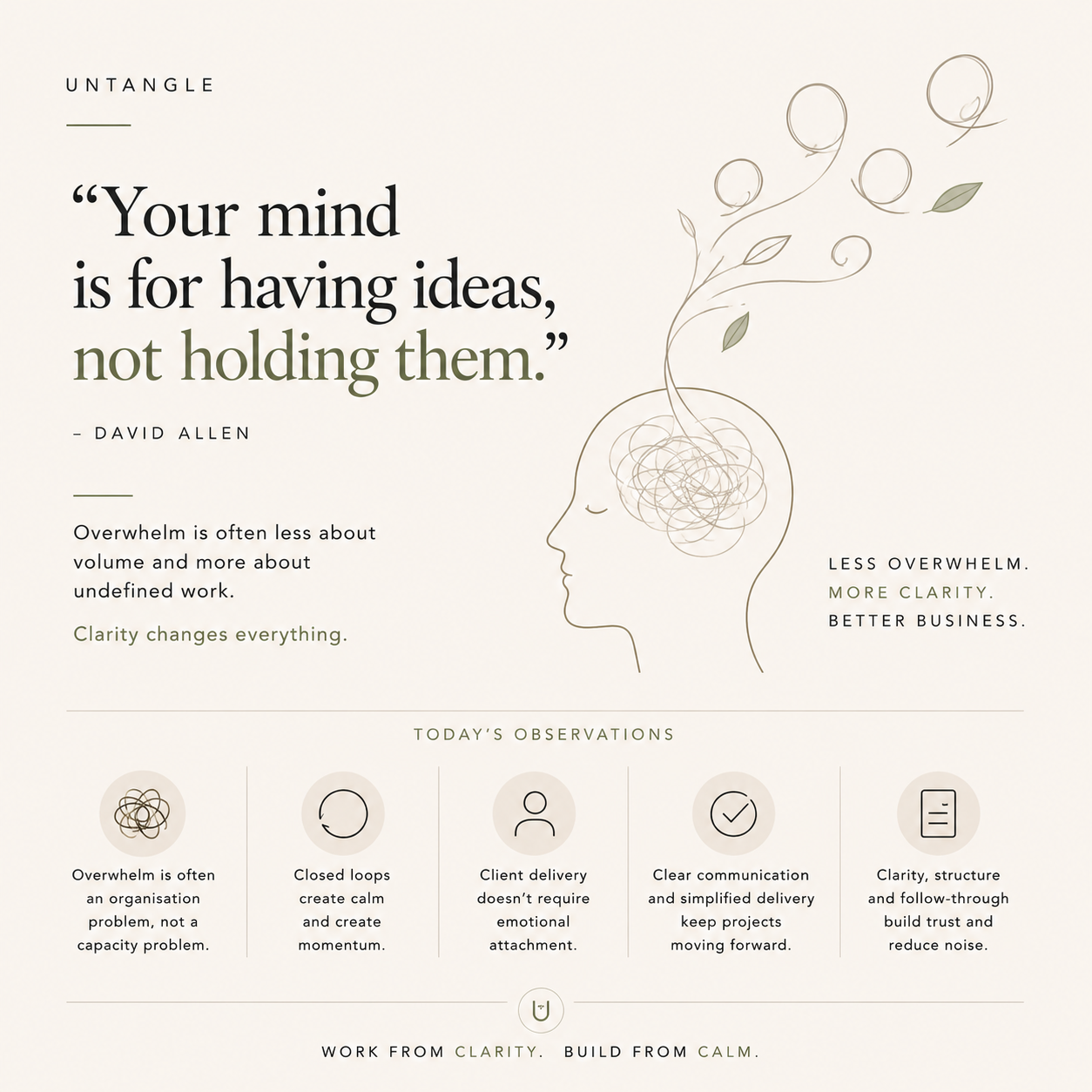
Pen, paper and thoughts. What I actually untangle.
Untangling inboxes, to dos, ideas. The inbox still guides me, it also trips me up. That’s why I use other tools like a CRM to hold all my client data and processes, Xero to handle all my accounts. socials to document my observations publicly, blogs to practice the art of articulation and writing and paper to capture random thoughts.
I start by identifying things that work now, but could work better. That feeling when you know you should fix something in your daily work routine, but it always gets put aside because life just takes over.
Most of the time I’m not building systems from scratch. I’m stepping into businesses, inboxes, workflows, and moving projects that already exist, then trying to make them that little bit easier to move forward. Sometimes, it’s just having a fresh pair of eyes on the problem.
Really, I think that’s the feeling I’m trying to reduce.
That overwhelmed feeling of:
inboxes full
too many open conversations
too many moving projects
too many plans sitting half-finished
Not necessarily because there’s too much work, but because it becomes hard to see what actually moves things forward.
The inbox still guides me, but it also trips me up.
If something sits there too long, it starts blending into everything else and it just falls off the radar even if it’s important.
So I try to move things out of the inbox and into places where they have momentum.
I believe in articulation - it starts with laying out the actions as they should happen rather than leaving it to chance.
Sometimes that happens in conversations with clients. Sometimes it’s just with myself.
That’s usually when I start noticing patterns.
Lists help for a while, but eventually, lists become messy too. So I try to move things into the next phase as quickly as possible.
For example, writing this started as a messy journal entry with pen and paper. Then I rewrote it as a draft email because I type faster than I write, and because I already know the end goal is to publish my thoughts, I have my blog draft page ready to go.
So now this draft can move somewhere useful:
a blog draft
a post draft
scheduled content
a framework I can return to later
Even just writing that sequencing matters more than you may realise.
Because once something has been drafted and scheduled, you’re no longer staring at a blank page every time you revisit it.
The same thing happens operationally.
I try to make incoming enquiries come through one central place:
website → CRM → inbox.
The information gets entered once and flows through the system instead of being manually rewritten over and over again. That’s really what a CRM is doing.
It’s storing contacts AND holding the next action so your brain doesn’t have to.
If I need to respond, follow up, or send a quote, the workflow already prompts the next step. That removes a surprising amount of decision fatigue.
The older I get, the more I think operational clarity is really about reducing unnecessary mental load and sleeping a bit easier at night.
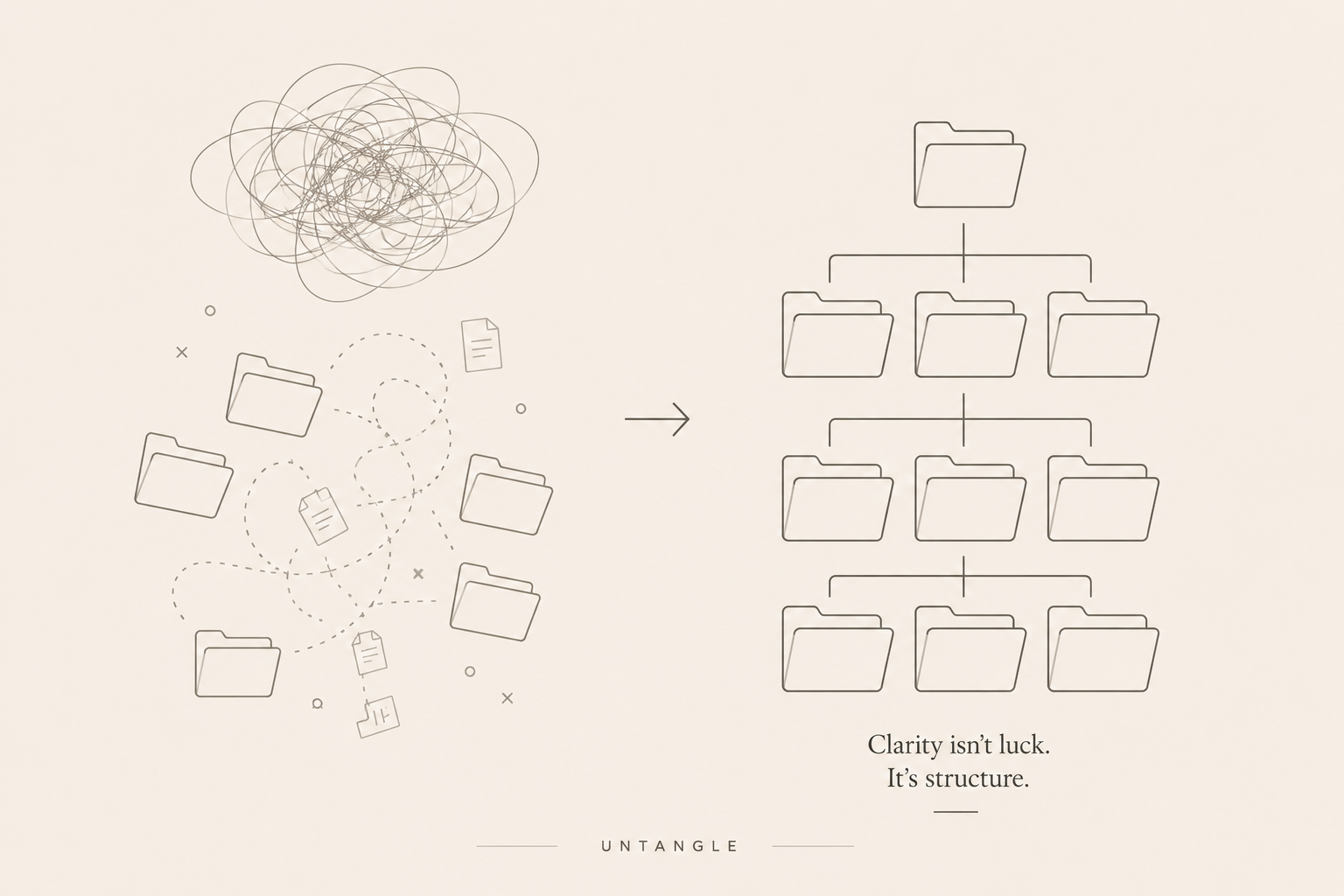
When your desktop starts becoming a tangle
Good systems often become invisible.
Untangle is an ongoing exploration of operational clarity, continuity and reducing friction inside businesses.
“For every minute spent organising, an hour is earned.”
— Attributed to Benjamin Franklin
Reference:
Benjamin Franklin Biography – Encyclopaedia Britannica
Something I noticed today while restructuring my Untangle folders was how much easier things become once information has a clear place to live, a clear purpose and the fewer folders the better.
I know it’s important but still find it easy to put structure off because things still technically work. Who wakes up and says to themselves, “today is a systems day” … there’s always something more important. And then there’s a deadline or I’m in a rush and then I really see how much this stuff slows me down. But it's not too bad just yet:
files can still be found
drafts still exist
ideas are still moving
the business keeps operating
Until eventually:
I spend hours looking for document or photo
duplication starts happening and there’s three versions of the same thing
and the mental load grows in the background and I just feel stressed
By the time most people stop to reorganise things, it’s usually because it’s become impossible to ignore.
Today I simplified a lot of my own structure around actual use:
website assets and content ideas
blog drafts
socials
case studies
operations
archives
It didn’t start pretty at first but by the third day I really got the hang of it. Who has three days to organise their files (clue, I do!). Aftwards, the sense of achievement was huge. Every time I open my laptop now I feel an eerie sense of calm and an overwhelming sense of achievement. Here is what I see every morning.
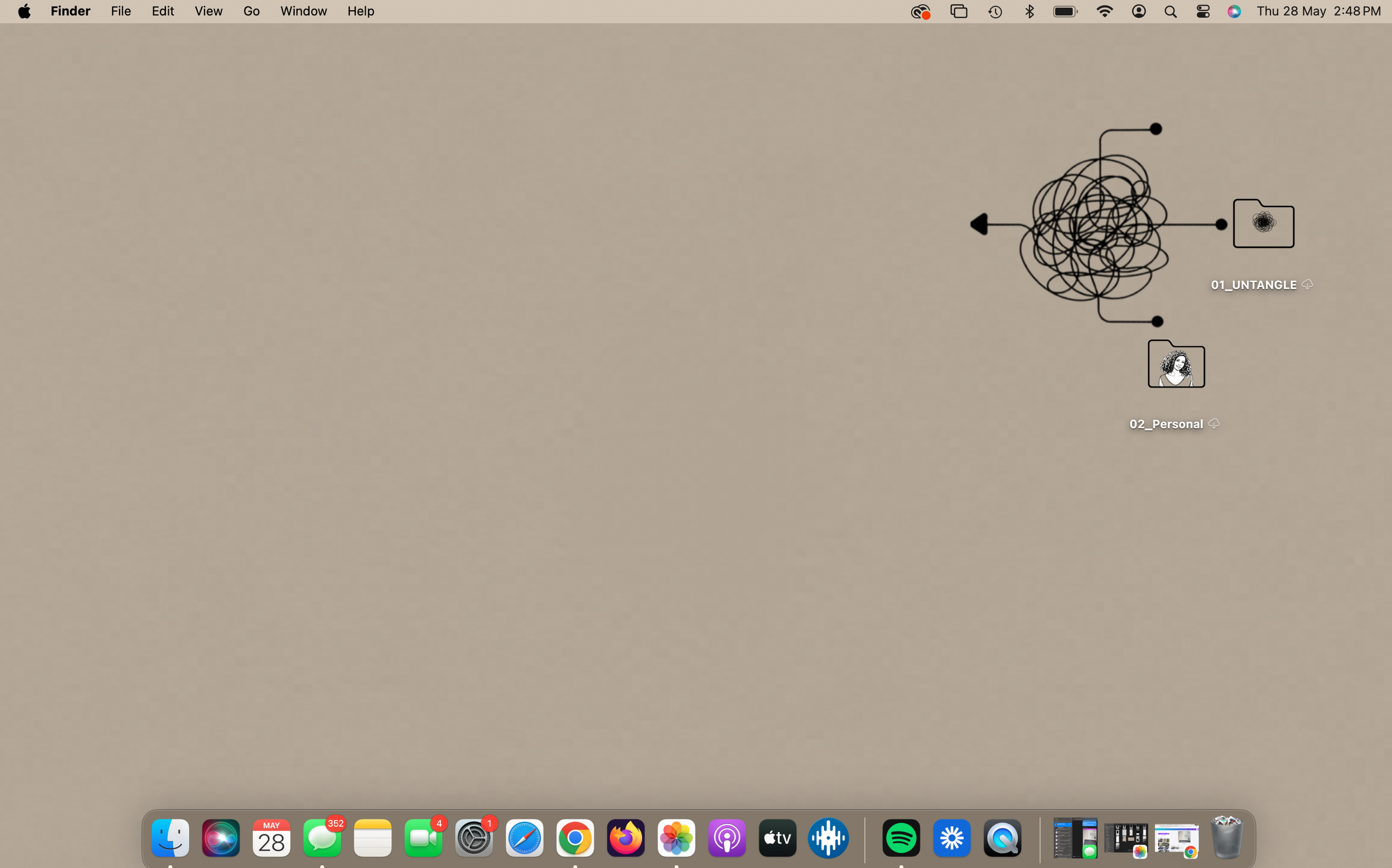
My desktop with my custom made icons - marvel at the order and calm
I went from feeling inexplicably stressed to feeling in control, once everything had a proper operational home.
I think good systems often work like that because they don’t just necessarily make businesses feel “more organised” but practically easier to:
continue
maintain
find
hand over
and pick up each morning without the background dread.
Untangle is an ongoing exploration of operational clarity, continuity and reducing friction inside businesses.
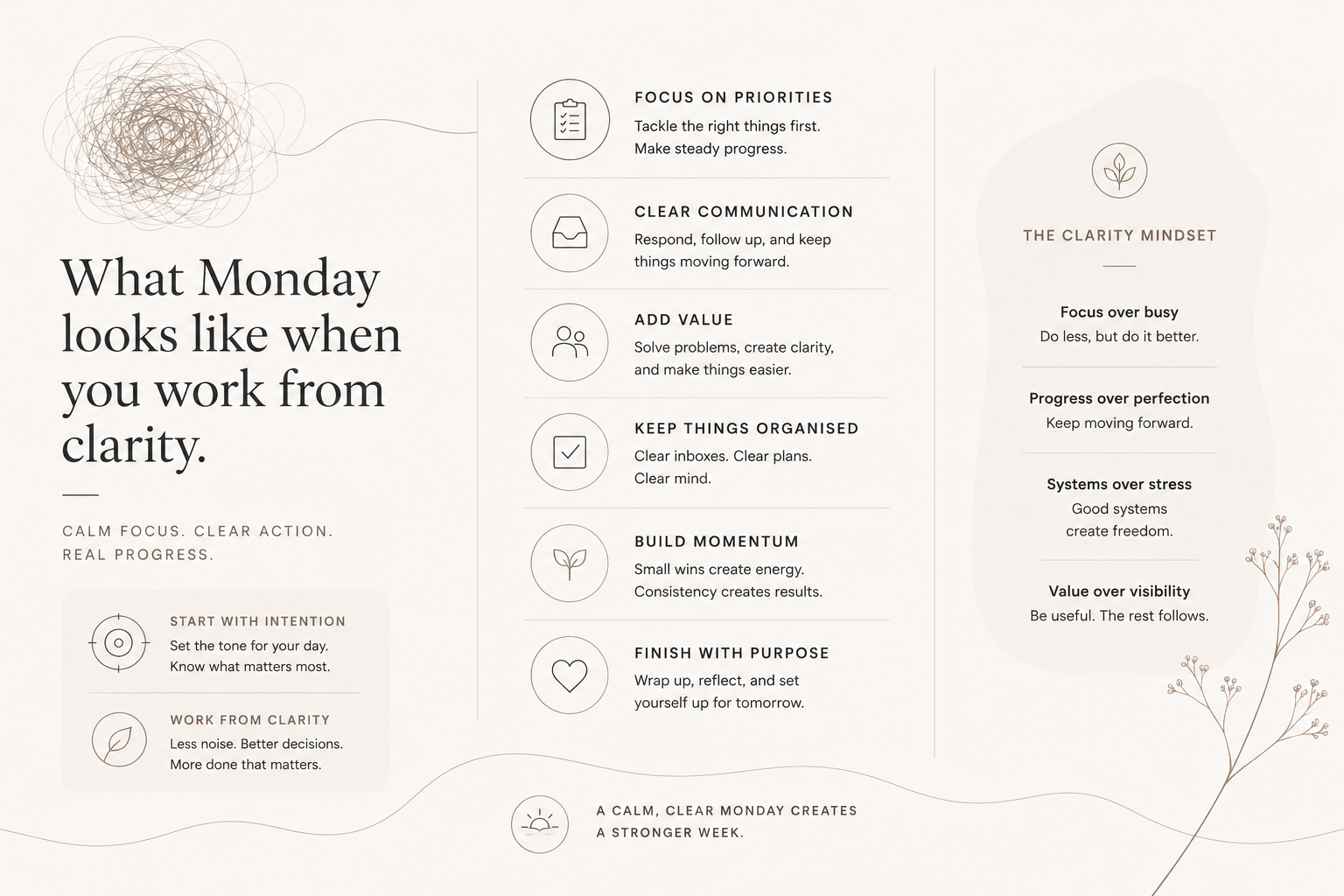
What Monday Could Look Like
Good systems often become invisible.
Untangle is an ongoing exploration of operational clarity, continuity and reducing friction inside businesses.
““It is not enough to be busy. So are the ants. The question is: What are we busy about?”
— Henry David Thoreau
“You do not rise to the level of your goals. You fall to the level of your systems.”
— James Clear
Can you relate to starting Monday and already feeling overwhelmed?
Too many tabs open, messages and priorities competing for attention. And they all need to be done now.
I’m learning that good work rarely comes from chaos so I’m aiming for that elusive perfect Monday, which looks like:
Respond to the important things and clearly see the priorities.
Move projects forward - even just a touch
Keep communication simple
And I propose to do that by creating systems that work so intuitively in the background - email has my enquiries, enquiries lead to a sequence of actions, and things get done calmly.
Less noise + better decisions + stronger systems = Calmer business.
That’s the kind of work I’m trying to build more of through Untangle.
“Simplicity is the ultimate sophistication.”
— Leonardo da Vinci
Untangle is an ongoing exploration of operational clarity, continuity and reducing friction inside businesses.
Building from a place of calm
Good systems often become invisible.
Untangle is an ongoing exploration of operational clarity, continuity and reducing friction inside businesses.
“Calm isn’t a passive, disengaged, lazy way of being (despite cultural messages to the contrary) — it’s a sense of presence.
It’s actually a high-performance state — our nervous system is relaxed and regulated, our attention is clear, and we can act from a non-reactive state..”
— Zen Habits
For a long time, I thought the goal was to become more efficient.
Faster replies.
More projects.
More output.
Better systems.
But lately I’ve realised the real goal is calmer work.
Not lazy work.
Not passive work.
Just work that doesn’t constantly feel like putting out fires.
Over the last few years I’ve worked across creative businesses, campaigns, clubs and growing teams, and the same pattern kept appearing:
Passionate people overwhelmed by scattered systems, unclear processes, too many tools, too many messages, too much noise.
Most people don’t actually need more complexity.
They need clarity.
That’s really where Untangle came from.
Not from wanting to build a “startup,” but from wanting to create calmer ways of working. Better workflows. Cleaner communication. Systems that support people instead of exhausting them.
I’m trying to build this slowly and honestly.
Less performative.
Less urgency.
Less pretending everything is bigger than it is.
More useful.
More sustainable.
More intentional.
The interesting thing is that calm creates better work anyway.
You think more clearly.
You notice more.
You make better decisions.
You stop rebuilding the same problems every week.
So this next chapter is less about chasing growth for the sake of it, and more about building something that feels steady, useful, creative, and real.
Working from calm.
Building from clarity.
That feels like a much better foundation.
“Calm also doesn’t mean no urgency ever — sometimes we have to work with urgency, but we can still come from a grounded calm as we do so.”
Reference:
Leo Babatua
Untangle is an ongoing exploration of operational clarity, continuity and reducing friction inside businesses.
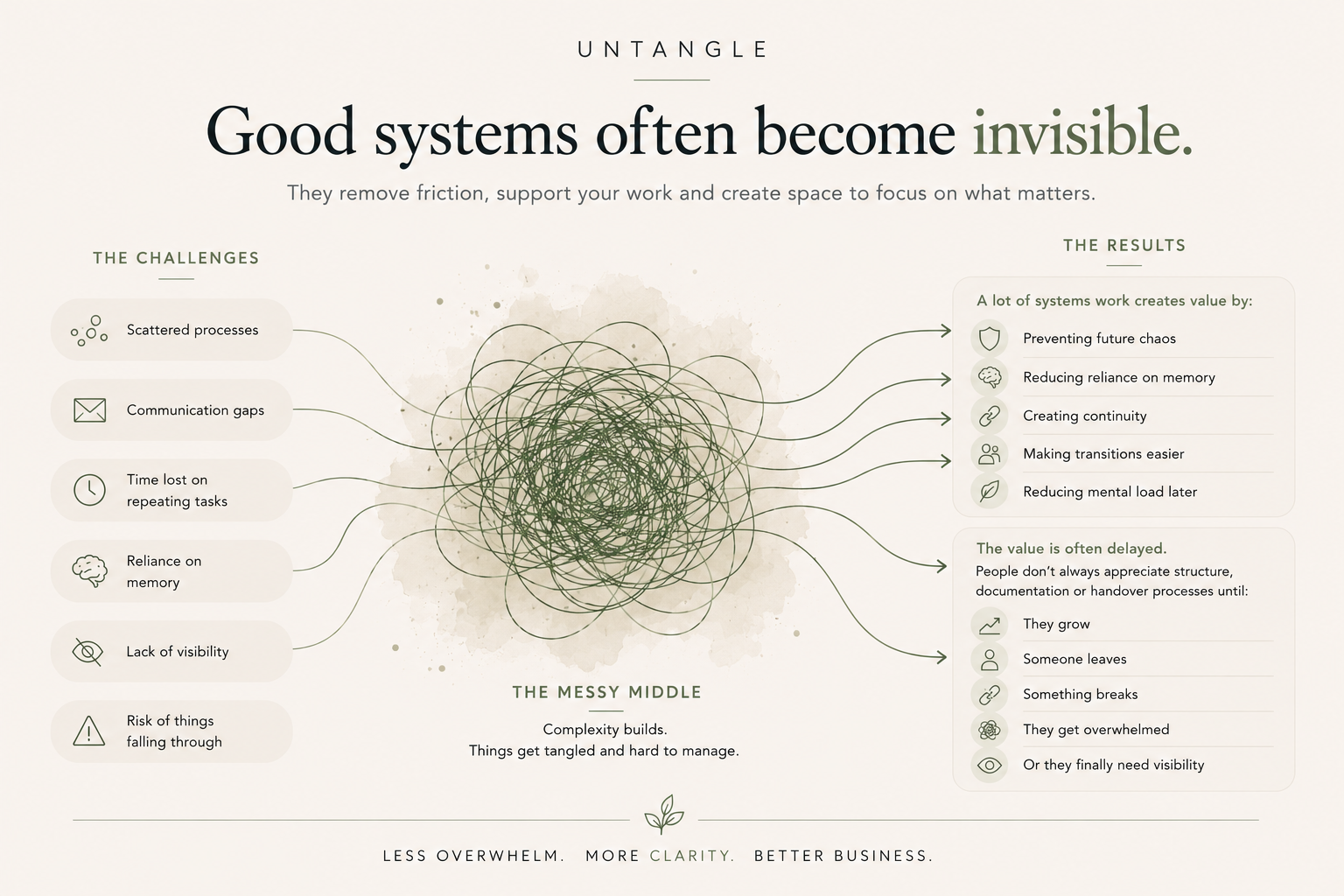
When good systems become invisible
Good systems often become invisible.
Untangle is an ongoing exploration of operational clarity, continuity and reducing friction inside businesses.
“When I am working on a problem, I never think about beauty. I think only how to solve the problem. But when I have finished, if the solution is not beautiful, I know it is wrong.”
“When I have finished, if the solution is not beautiful, I know it is wrong.”
— Buckminster Fuller
A few years ago I worked with a founder to help structure workflows and operations for a growing online course business based in Australia.
Part of the project involved simplifying how the business operated behind the scenes:
workflows
onboarding
automations
communication structure
and handover documentation
The systems were built using ActiveCampaign, alongside a full walkthrough and Loom handover video designed to make the setup easier to understand and manage long term.
Recently, I noticed the Loom video had only been revisited once in almost three years.
At first I wondered whether the value simply hadn’t landed at the time.
But the more I thought about it, the more I realised something else:
If people don’t need to constantly revisit the systems, documentation or workflows, that can actually be a sign the structure worked.
Good operational systems often become:
intuitive
embedded
part of everyday operations
People stop thinking about them because the friction disappears.
The later rewatch may simply have been:
reassurance
a memory refresh
revisiting context years later
That’s something I’ve become increasingly interested in through Untangle.
Not building overly complicated systems, but helping reduce future friction by creating calmer operational structure that’s easier to manage, hand over and grow over time.
Because the value of systems work is often delayed.
People don’t always immediately appreciate:
structure
handover
documentation
workflows
Until:
they grow
someone leaves
something breaks
they get overwhelmed
they finally need visibility
Then suddenly, the work becomes incredibly valuable.
A lot of operational work creates value by:
preventing future chaos
reducing reliance on memory
creating continuity
making transitions easier
reducing mental load later
The best systems often aren’t the ones people constantly notice.
They’re the ones that quietly support the business in the background so people can focus on the work itself.
“When I am working on a problem, I never think about beauty. I think only how to solve the problem. But when I have finished, if the solution is not beautiful, I know it is wrong.”
“When I have finished, if the solution is not beautiful, I know it is wrong.”
— Buckminster Fuller
Reference:
R. Buckminster Fuller
Untangle is an ongoing exploration of operational clarity, continuity and reducing friction inside businesses.
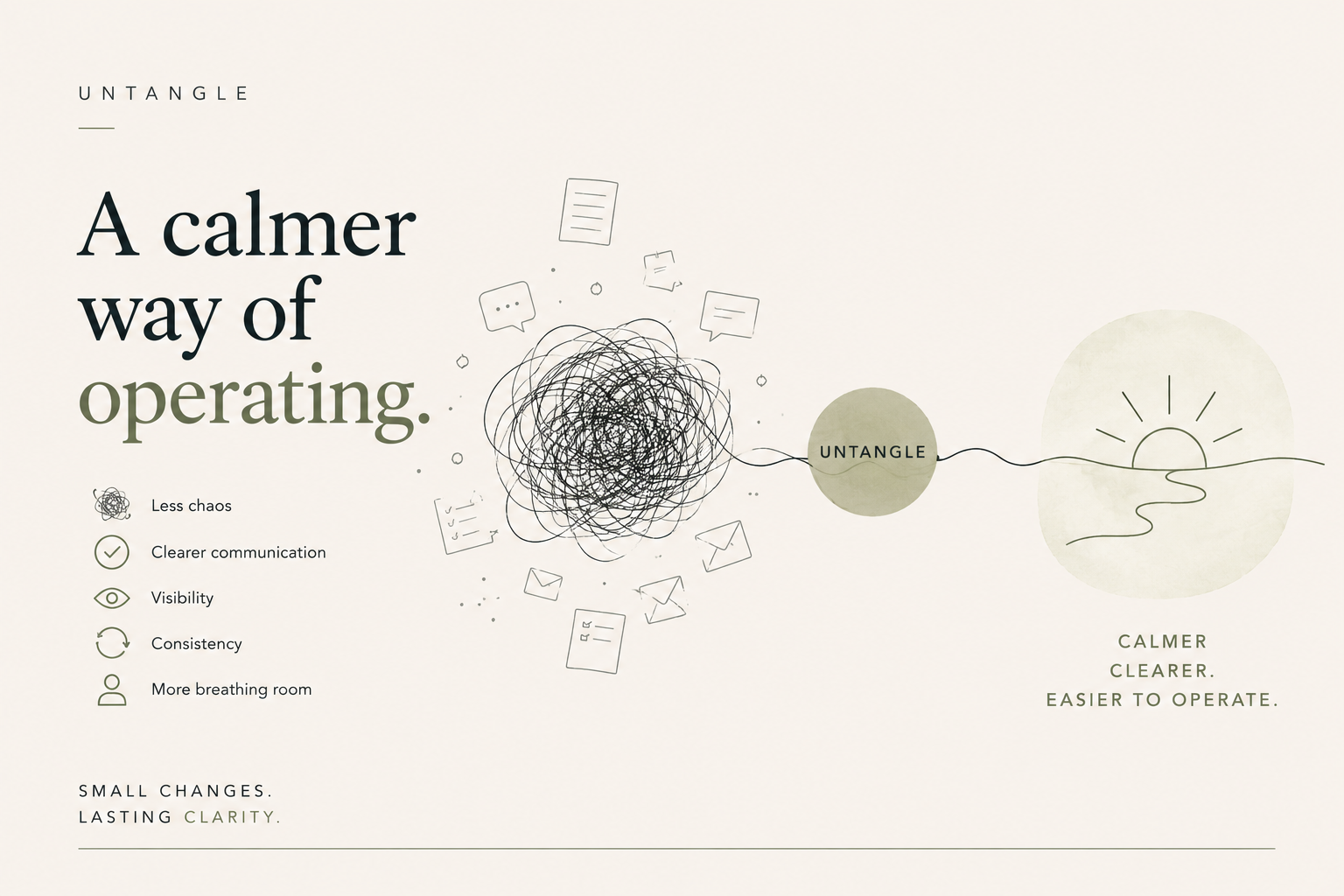
A calmer way of operating
A Calmer Way of Operating
Untangle is an ongoing exploration of operational clarity, continuity and reducing friction inside businesses.
“We can’t control systems or figure them out. But we can dance with them.”
— Donella Meadows
Something I’ve realised recently is that most business owners don’t actually want “more systems”.
What they really want is:
less chaos
fewer manual tasks
clearer communication
more visibility
more consistency
and a bit more breathing room
The interesting thing is that once businesses become overwhelmed, even the idea of “fixing the systems” can start feeling like another huge project.
That’s often why operational problems stay unresolved for so long.
Not because people don’t care.
Because they already have too much operational weight sitting in their heads.
That’s something I’ve been thinking about a lot while building Untangle.
I’m not particularly interested in turning small businesses into overly corporate systems.
What interests me more is creating calmer ways of operating.
Reducing friction.
Creating visibility.
Making things easier to maintain.
Helping businesses rely a little less on memory and manual effort over time.
Sometimes that looks like:
clearer workflows
reorganising assets
improving communication structure
simplifying content processes
documenting recurring tasks
or reducing duplicated manual work
I don’t promise one dramatic transformation, but rather smaller operational shifts that slowly create:
more clarity
less stress
easier handovers
smoother communication
and more breathing room internally
The businesses I’ve worked with over the years often didn’t need more ambition, more tools or more complexity - just a few vital dots needed connecting i.e. website - talks to a crm - which talks to operations.
Untangle is about my observations and articulating how I apply them. The aim is to offer thoughtful operational support. My work is designed to simplify the parts of businesses that become tangled over time.
Reference:
Donella Meadows, Thinking in Systems
https://donellameadows.org/archives/thinking-in-systems-a-primer/
Untangle is an ongoing exploration of operational clarity, continuity and reducing friction inside businesses.
The businesses that look busiest often have the least visibility
The businesses that look busiest often have the least visibility.
Untangle is an ongoing exploration of operational clarity, continuity and reducing friction inside businesses.
“A wealth of information creates a poverty of attention.”
— Herbert Simon
One thing I keep noticing is that overwhelmed businesses often aren’t disorganised because people don’t care.
Usually it’s the opposite.
They care deeply, work constantly and keep adding systems, workarounds and quick fixes just to keep things moving.
From the outside, the business can look successful:
busy inboxes
active social media
growing enquiries
constant movement
lots happening
But internally, visibility slowly starts disappearing.
The business is failing, sort of just stalling. It’s funny how complexity accumulates much faster than structure.
Over time:
files end up scattered
communication becomes fragmented
reporting gets delayed
workflows become reactive
approvals live in text messages
assets sit across different platforms
and important operational knowledge starts living inside specific people
At first, most businesses compensate manually because people remember things. They fill gaps, chase information. It’s almost like they become the system themselves.
That works for a while.
Until the operational load becomes too heavy to carry mentally.
That’s usually the point where businesses start feeling:
harder to manage
harder to hand over
harder to scale
and strangely harder to see clearly from the inside
I’ve seen versions of this across:
creative studios
course businesses
sports organisations
service businesses
campaigns
and founder-led teams
Different industries.
Very similar operational patterns.
One of the biggest misconceptions about systems work is that it’s mainly about automation.
A lot of the time, it’s actually about visibility.
Being able to answer simple questions without stress:
Where does this live?
Who owns this?
What happens next?
Has this been followed up?
Which version is correct?
Can someone else step in if needed?
That kind of clarity creates a surprising amount of breathing room because people stop carrying so much operational information in their heads all the time.
That’s increasingly what I’m interested in through Untangle by helping businesses rely a little less on memory alone.
Reference:
Herbert A. Simon, Designing Organizations for an Information-Rich World
https://en.wikipedia.org/wiki/Herbert_A._Simon
Untangle is an ongoing exploration of operational clarity, continuity and reducing friction inside businesses.
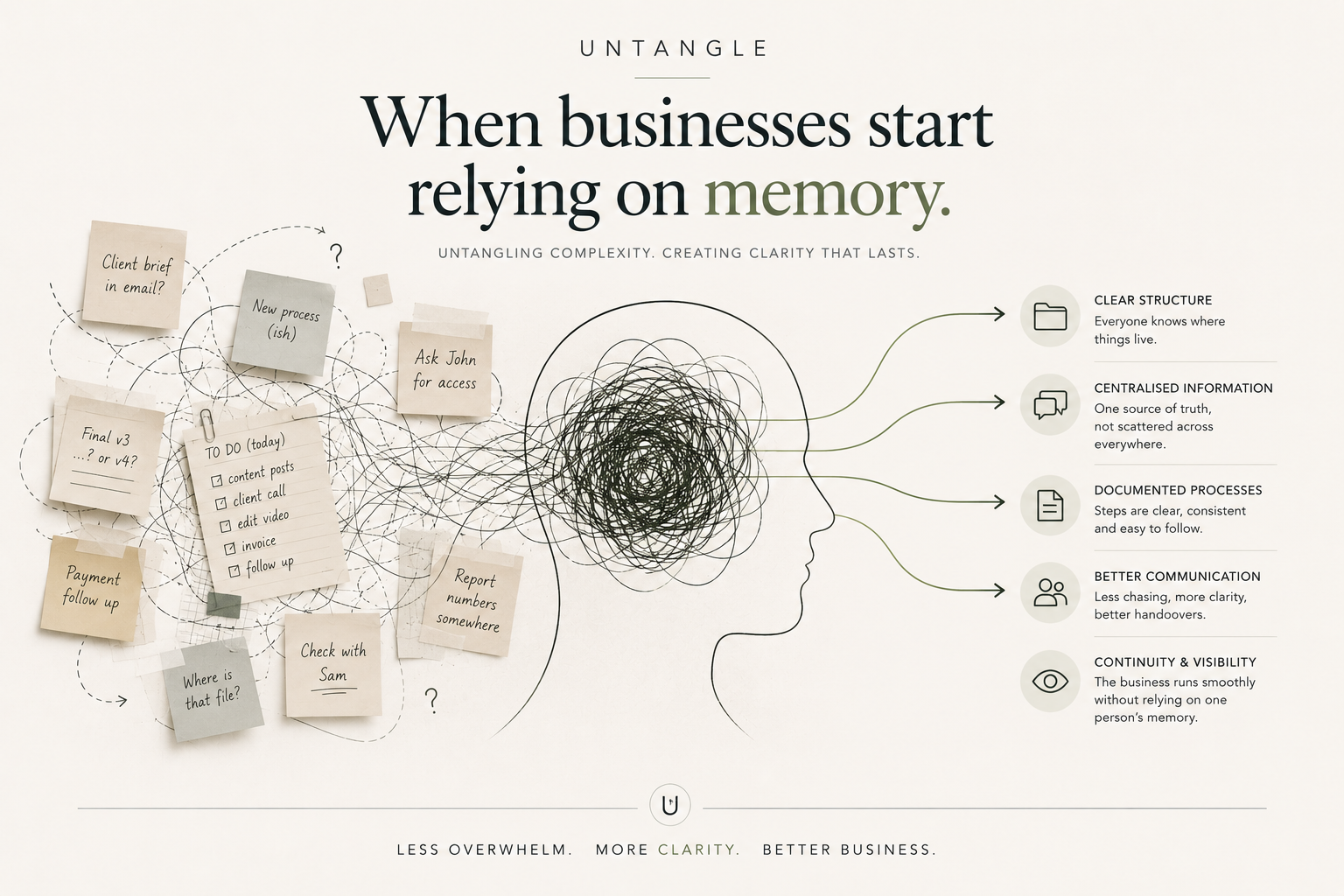
When businesses start relying on memory
When businesses start relying on memory
Untangle is an ongoing exploration of operational clarity, continuity and reducing friction inside businesses.
“Every system is perfectly designed to get the results it gets.”
— W. Edwards Deming
Over the last 12 years, I’ve worked across a surprisingly wide range of businesses.
Saunas.
Online education.
Photography.
Content production.
Performing arts schools.
Sports clubs.
Campaigns.
Creative businesses.
On the surface, they all looked completely different.
But underneath, I kept noticing the same operational patterns appearing again and again.
At first, most businesses operate fairly simply.
Everyone knows where things are.
The founder holds most of the knowledge.
Communication feels manageable.
People remember how things work.
Then the business grows.
More staff.
More clients.
More content.
More platforms.
More moving parts.
And slowly, the business starts relying on memory instead of structure.
Not intentionally.
Usually, because people are moving quickly, solving problems in real time and doing whatever they can to keep things running.
Over time:
files end up scattered
communication becomes fragmented
workflows become reactive
handovers stop happening properly
and important information starts living inside specific people instead of systems
At first, it still works.
Until:
someone leaves
something breaks
the business grows further
visibility disappears
or the mental load simply becomes too heavy to carry manually
That’s the point where operational friction usually becomes impossible to ignore.
I’ve seen versions of this pattern across businesses like:
Clearlight Saunas, Alpha AML, Black on Black, Social Lover, TRFC and Excel School of Performing Arts
Different industries.
Very similar tension underneath.
At Clearlight Saunas, I saw what happens when a business scales over many years and systems need to evolve alongside growth.
At Alpha AML, the work centred around workflows, automations and handover systems designed to create continuity over time.
With Black on Black and Social Lover, the operational challenge often became balancing creative delivery with bookings, editors, contractors, timelines, assets and client communication across multiple moving parts.
At TRFC, complexity came through committees, registrations, volunteers, sponsors, communication channels and handovers between different groups of people.
At Excel School of Performing Arts, the challenge centred around coordination, communication and keeping growing operations manageable behind the scenes.
The industries were different, but the underlying operational weight was often the same.
What I’ve become increasingly interested in through Untangle is not creating overly corporate systems or adding unnecessary complexity.
It’s helping simplify the parts of businesses that slowly become tangled over time.
Because a lot of systems work creates value by:
preventing future chaos
reducing reliance on memory
creating continuity
making transitions easier
reducing mental load later
The interesting thing is that the value is often delayed.
People don’t always appreciate:
structure
handover
documentation
workflows
Until they finally need them.
Then suddenly, they become incredibly valuable.
The best systems often aren’t the ones people constantly notice.
They’re the ones that make businesses easier to operate, easier to hand over and easier to grow without everything depending on one person holding it all together mentally.
Untangle is an ongoing exploration of operational clarity, continuity and reducing friction inside businesses.
“Every system is perfectly designed to get the results it gets.”
— W. Edwards Deming
Reference:
W. Edwards Deming, The New Economics for Industry, Government, Education